What Did Bilbow Call His Story to the Shire and Back Again
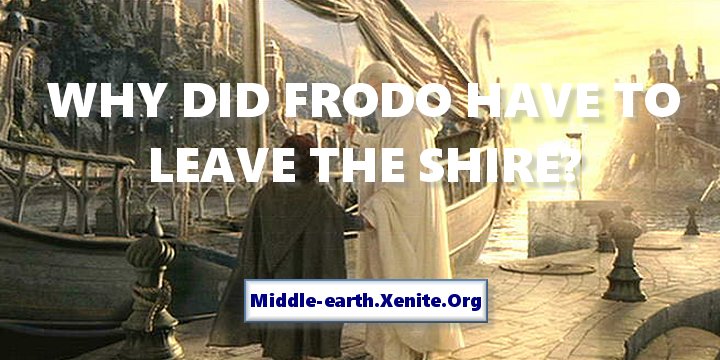
Q: Why Did Frodo Leave Middle-earth and the Shire?
ANSWER: To be spiritually healed earlier he died, according to J.R.R. Tolkien.
However this is actually not a simple question. People tin quote the books (every bit I exercise below) but many readers are notwithstanding not sure of WHY Frodo had to go out. After all, if he was going to the Immortal Lands to become immortal as a reward for his cede, that would be something. But Frodo and Bilbo (and Sam) did not become immortal (despite all the "Frodo Lives!" graffiti). If anything, passing over Sea to Valinor speeded their deaths, but according to J.R.R. Tolkien information technology was necessary to help them heal from the spiritual and emotional damage that the 1 Ring had inflicted on each of them.
The first hint of Frodo's impending departure comes when he dreams of sailing over the sea in the business firm of Bombadil. However, information technology'due south actually not until the chapter "Many Partings" in The Render of the King that the reader is given a clear and specific warning that Frodo will leave Middle-earth:
'It is true that I wish to become back to the Shire,' said Frodo. 'But first I must go to Rivendell. For if there could be anything wanting in a time so blessed, I missed Bilbo; and I was grieved when among all the household of Elrond I saw that he was not come up.'
'Exercise you lot wonder at that, Band-bearer?' said Arwen. 'For you know the power of that affair which is at present destroyed; and all that was done by that power is now passing abroad. But your kinsman possessed this thing longer than you. He is aboriginal in years now, according to his kind; and he awaits you lot, for he will non once again make whatsoever long journey save one.'
'Then I beg leave to depart presently,' said Frodo.
'In seven days we volition go,' said Aragorn. 'For nosotros shall ride with you far on the road, even as far as the state of Rohan. In iii days now Éomer volition return here to bear Théoden back to residue in the Mark, and nosotros shall ride with him to accolade the fallen. But now earlier you get I volition confirm the words that Faramir spoke to you, and you are made gratis for ever of the realm of Gondor; and all your companions likewise. And if at that place were any gifts that I could give to match with your deeds y'all should have them; but whatsoever you want you shall take with you, and you shall ride in accolade and arrayed as princes of the state.'
But the Queen Arwen said: 'A gift I will give you. For I am the daughter of Elrond. I shall not get with him now when he departs to the Havens; for mine is the choice of Lúthien, and as she and then accept I chosen, both the sugariness and the bitter. But in my stead yous shall get, Band-bearer, when the time comes, and if you so desire it. If your hurts grieve you lot still and the memory of your burden is heavy, so you may pass into the West, until all your wounds and weariness are healed. But vesture this now in memory of Elfstone and Evenstar with whom your life has been woven!'
And she took a white gem like a star that lay upon her breast hanging upon a silver chain, and she set the chain about Frodo'due south neck. 'When the retention of the fear and the darkness troubles you lot,' she said, 'this will bring you aid.'
Tolkien really had a few things to say about Frodo in his individual correspondence. For example, in Letter No. 151 (which he wrote in 1954) Tolkien noted:
Frodo is not intended to be another Bilbo. Though his opening style is not wholly un-kin. But he is rather a study of a hobbit broken past a brunt of fear and horror — broken down, and in the end made into something quite different. None of the hobbits come out of it in pure Shire-way. They wouldn't. But you have got Samwise Gamwichy (or Gamgee).
Tolkien spoke briefly about Frodo's failure (to resist the Band at the cease of the Quest) in several letters but perhaps explained matters all-time in Alphabetic character No. 246, which he wrote in 1963:
I do not think that Frodo's was a moral failure. At the last moment the pressure of the Band would achieve its maximum – incommunicable, I should have said, for any one to resist, certainly afterward long possession, months of increasing torment, and when starved and wearied. Frodo had done what he could and spent himself completely (every bit an instrument of Providence) and had produced a situation in which the object of his quest could be achieved. His humility (with which he began) and his sufferings were justly rewarded past the highest accolade; and his exercise of patience and mercy towards Gollum gained him Mercy: his failure was redressed.
He goes on at length a footling after:
Frodo undertook his quest out of love – to salve the world he knew from disaster at his ain expense, if he could; and also in complete humility, acknowledging that he was wholly inadequate to the job. His real contract was only to do what he could, to endeavour to find a way, and to go as far on the road as his strength of heed and body allowed. He did that. I do not myself see that the breaking of his mind and will under demonic pressure later torment was whatsoever more a moral failure than the breaking of his torso would have been – say, past existence strangled by Gollum, or crushed past a falling rock.
That appears to have been the judgement of Gandalf and Aragorn and of all who learned the full story of his journeying. Certainly cipher would be concealed past Frodo! But what Frodo himself felt about the events is quite another affair.
He appears at kickoff to have had no sense of guilt (Iii 224-5); he was restored to sanity and peace. But then he idea that he had given his life in cede: he expected to die very soon. But he did not, and one can observe the ailment growing in him. Arwen was the first to observe the signs, and gave him her gem for comfort, and thought of a way of healing him.* Slowly he fades 'out of the picture', saying and doing less and less. I think it is clear on reflection to an attentive reader that when his dark times came upon him and he was conscious of being 'wounded by knife sting and tooth and a long brunt' (Iii 268) it was not only nightmare memories of past horrors that affected him, simply also unreasoning cocky-reproach: he saw himself and all that he had done as a broken failure. 'Though I may come to the Shire, it will non seem the aforementioned, for I shall not be the same.' That was actually a temptation out of the Dark, a last flicker of pride: desire to take returned as a 'hero', not content with existence a mere instrument of skillful. And information technology was mixed with some other temptation, blacker and yet (in a sense) more than merited, for withal that may exist explained, he had not in fact cast away the Ring by a voluntary deed: he was tempted to regret its destruction, and even so to want it. 'It is gone for ever, and now all is dark and empty', he said as he wakened from his sickness in 1420.
'Alas! there are some wounds that cannot be wholly cured', said Gandalf (III 268) – not in Middle-earth. Frodo was sent or allowed to pass over Body of water to heal him – if that could be done, earlier he died. He would have eventually to 'pass away': no mortal could, or can, abide for ever on earth, or within Time. So he went both to a purgatory and to a reward, for a while: a menstruation of reflection and peace and a gaining of a truer understanding of his position in littleness and in greatness, spent still in Time amid the natural beauty of 'Arda Unmarred', the Earth unspoiled by evil.
Bilbo went too. No doubtfulness as a completion of the plan due to Gandalf himself. Gandalf had a very great affection for Bilbo, from the hobbit's childhood onwards. His companionship was actually necessary for Frodo's sake – it is difficult to imagine a hobbit, fifty-fifty i who had been through Frodo's experiences, being really happy fifty-fifty in an earthly paradise without a companion of his own kind, and Bilbo was the person that Frodo near loved. (Cf III 252 lines 12 to 21 and 263 lines 1-2.)
But he as well needed and deserved the favour on his own account. He bore however the mark of the Ring that needed to be finally erased: a trace of pride and personal possessiveness. Of grade he was sometime and dislocated in mind, merely it was withal a revelation of the 'black marker' when he said in Rivendell (III 265) 'What's go of my ring, Frodo, that you took away?'; and when he was reminded of what had happened, his immediate reply was: 'What a pity! I should have liked to see it again'. As for reward for his hurting, information technology is hard to feel that his life would exist complete without an experience of 'pure Elvishness', and the opportunity of hearing the legends and histories in full the fragments of which had so delighted him.
Information technology is clear, of course, that the plan had actually been made and concerted (by Arwen, Gandalf and others) before Arwen spoke. But Frodo did not immediately take information technology in; the implications would slowly be understood on reflection. Such a journeying would at first seem something not necessarily to be feared, fifty-fifty every bit something to await forrard to – so long equally undated and postponable. His real desire was hobbitlike (and humanlike) merely 'to be himself' again and become back to the old familiar life that had been interrupted. Already on the journey back from Rivendell he of a sudden saw that was not for him possible. Hence his cry 'Where shall I find remainder?' He knew the answer, and Gandalf did non answer. Equally for Bilbo, it is likely that Frodo did not at first understand what Arwen meant by 'he will not again brand whatsoever long journeying relieve one'. At any rate he did not associate it with his own case. When Arwen spoke (in TA 3019) he was even so young, non yet 51, and Bilbo 78 years older. But at Rivendell he came to understand things more clearly. The conversations he had there are not reported, but enough is revealed in Elrond's farewell 3 267. From the onset of the first sickness (Oct. 5, 3019) Frodo must have been thinking nearly 'sailing', though still resisting a final decision — to go with Bilbo, or to go at all. It was no doubt later his grievous illness in March 3020 that his mind was made up.
* It is not made explicit how she could arrange this. She could not of course just transfer her ticket on the boat similar that! For any except those of Elvish race 'sailing West' was not permitted, and any exception required 'authority', and she was not in direct advice with the Valar, especially non since her option to go 'mortal'. What is meant is that information technology was Arwen who first thought of sending Frodo into the West, and put in a plea for him to Gandalf (direct or through Galadriel, or both), and she used her ain renunciation of the correct to go West as an argument. Her renunciation and suffering were related to and enmeshed with Frodo's : both were parts of a plan for the regeneration of the state of Men. Her prayer might therefore be specially effective, and her plan take a certain disinterestedness of exchange. No doubt it was Gandalf who was the authority that accustomed her plea. The Appendices evidence clearly that he was an emissary of the Valar, and virtually their plenipotentiary in accomplishing the plan against Sauron. He was also in special accordance with Cirdan the Ship-primary, who had surrendered to him his band then placed himself nether Gandalf's command. Since Gandalf himself went on the Ship in that location would be and then to speak no trouble either at embarking or at the landing.
The story behind Frodo and Bilbo's departure is circuitous — then it seems to me — considering it introduces an entirely new level of composure to the story of Middle-globe. In that location are some wounds inflicted upon Middle-earth's inhabitants (past those greater powers whose struggles bear upon the inhabitants) which tin only be healed by the greater powers themselves. The real conflict was not between "good" and "evil" just rather between opposing points of view (the Sauronic view that Middle-earth could be ordered co-ordinate to a college wisdom, opposed by the non-interference of the Valar) the flaws and merits of which (in God's eyes) had not nonetheless been fully illuminated for mortals. Gollum/Smeagol (and very briefly Deagol), Bilbo, Frodo, and Sam had all become vessels of Sauron's ability and thus drawn into that conflict on the plane of the greater powers, a plane where the Incarnate mortals of Middle-earth were not designed to function and be. Merely touching the Ring appears to have been sufficient to take doomed a mortal — so even Isildur was drawn into that disharmonize, merely like Deagol and Smeagol he was afforded no opportunity to seek healing (which had not yet been offered). I must wonder what became of their souls, wounded and not redressed. Tolkien did consider that Gollum — having been mean and tending toward selfishness and small acts of evil to begin with — was simply propelled further along the path he had chosen past the Ring. It'southward non clear he would have committed murder without being influenced by the Band, but he was already biting and secretive.
Isildur had been a heroic figure fifty-fifty in Numenor, where he risked his life to salvage a sapling of the White Tree of Armenelos, suffering grievous wounds but preserving the aboriginal heritage of the relationship between the Eldar and the Firm of Elros. In Middle-earth Isildur had also been a great leader in the war against Sauron. But like Frodo later on him Isildur was unable to withstand the will of the Ring — and so only recently separated from Sauron and possibly "feeling stronger" than in Frodo'south twenty-four hours. Once having given in to the Band Isildur became its servant, even if only unwilling. In "The Disaster of the Gladden Fields" there is a hint of regret in Isildur's final words, just Tolkien presents the tale every bit something composed in Arnor (or Rivendell) in the Third Age, and thus the dialog was conjectural by either an Elf or Dunadan scholar.
This tale is, perhaps, the but instance of Arnorian literature that Tolkien equanimous — although the "final" version as given in Unfinished Tales of Numenor and Middle-world is said to have been composed in Elessar's day, and therefore was probably a Gondorian estimation of the more than ancient legend, enhanced with details uncovered by Elessar's investigations of Orthanc. "Akallabeth" is said to have been written past Elendil, and some people might contend that is the only true Arnorian literature — but Elendil was more Numenorean than Arnorean in my opinion.
I advise that these things are significant for in that location is a question that Tolkien never direct answered: what would accept happened had Gil-galad and Elendil survived and defeated Sauron? In the book Sauron dies from the wounds Elendil inflicts on him; Isildur only cuts the ring from Sauron's dead or dying body. In the picture show Isildur slays Sauron by cutting the Dark Lord'due south armored ring finger with a miraculous stroke of good fortune. Confronted by the One Ring, would Gil-galad and Elendil have fought for command of it? Did their deaths perhaps relieve them from a fate like to that of Deagol and Smeagol?
We will never know.
See likewise …
- Why Did the Elves Leave Heart-globe?
# # #
Have you read our other Tolkien and Eye-globe Questions and Answers articles?
Follow The Centre-earth Weblog | |
| | Click here to follow The Middle-earth Web log on Twitter: @tolkien_qna. The Middle-world Web log's RSS Feed (summaries only) |
Source: https://middle-earth.xenite.org/why-did-frodo-leave-middle-earth-and-the-shire/

Postar um comentário for "What Did Bilbow Call His Story to the Shire and Back Again"