Is the Beef Carcass Has a Spare Rib
MEAT CUTS & GRADING
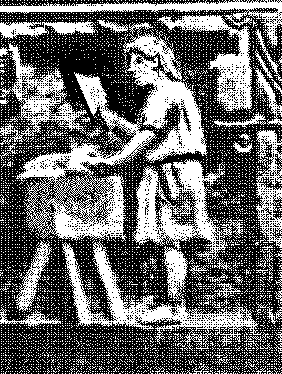
Hither is a Roman butcher in action, but we will only look at meat cutting for Canada (which is the same as the US), England, and Japan.
Cuts of beef
The get-go step in breaking the carcass is to split it into primal cuts that can be handled more easily. The primal cuts stand for adequately closely to the units that a retail butcher might order from a wholesaler or slaughter-house. The central cuts of beefiness are shown below. The separation of the forequarter and the hindquarter leaves simply the last rib on the hindquarter. 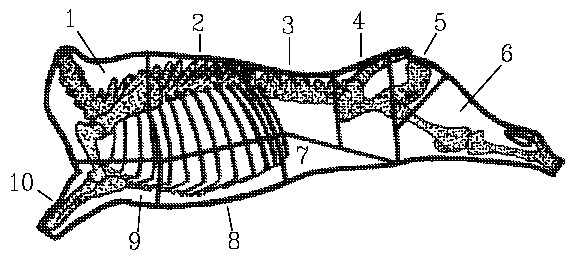
- ane = chuck
- two = rib,
- 3 = short loin,
- four = sirloin,
- v = rump,
- 6 = circular,
- seven = flank,
- eight = plate,
- 9 = brisket,
- x = shank.
- Separate the chuck
- Separate the rib from the plate by an inductive to posterior cut. This separation may be made much nearer to the vertebral column than the shown in the diagram.
- Separate the chuck from the brisket by a cut that is perpendicular to the fourth rib at a point about 1 cm proximal to the olecranon process of the elbow.
- The shank may be cut into thick slices, the shank knuckle slices are proximal.
- Earlier breaking the hindquarter, trim off the backlog fat nearly the pubis and over the posterior role of the abdominal muscles. Anterior to the rectus femoris, at a bespeak where the tensor fascia lata muscle reaches its about distal extent, start a separation that ends on rib 12, about twenty cm from the vertebral cavalcade. This detaches the flank.
- Carve up the circular from the rump with a cutting that passes about 1 cm distal to the ischium and terminates only after passing through the head of the femur.
- Carve up the rump from the sirloin with a cut that passes between sacral vertebrae 4 and v, and terminates just ventral to the acetabulum of the pelvis.
- Separate the sirloin from the short loin with a cut that is perpendicular to the vertebral cavalcade and which passes between lumbar vertebrae 5 and half dozen.
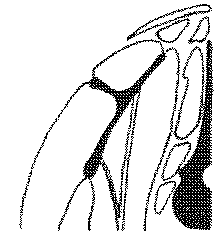 from the rib with a perpendicular cut through the vertebral cavalcade, level with the intercostal muscles between the dorsal parts of ribs 4 and 5.
* less tender cuts to braise, stew or pot roast,
** medium tender cuts, adept for cooking past moist rut,
*** tender meat for roasting, broiling or frying.
- The rib cut is separated into rib steaks*** or standing rib roasts*** by cuts made perpendicularly to the vertebral column. Rib-centre*** or delmonico*** steaks are composed of sections of the spinalis dorsi together with the longissimus dorsi muscle.
- If you are new to this game, a fundamental point to notation is how to distinguish steaks through the rib region
- The chuck is sliced in planes that are parallel to rib 4 to make blade steaks** or blade pot roasts**.
- Arm steaks*, arm pot roasts* or cross cut ribs*
- Brisket* is sold in chunks to be braised or cooked in liquid. The shank* is cutting into thick slices that are perpendicular to the radius and ulna.
- The plate may be divided into cubes of rib bone and musculus, and sold every bit short ribs*. The flat mass of meat located ventro-laterally to the rib muzzle is ordinarily rolled, tied, and cutting into cylindrical cuts of plate*.
- Abdominal muscles may be isolated from the flank to brand flank steaks*.
- The brusk loin is sliced into steaks perpendicularly to the vertebral cavalcade.
- The near anterior steaks are the wing or social club steaks***, and nearly all their meat is derived from the longissimus dorsi.
- Next are the T bone steaks*** and these gain actress meat from the psoas major towards the posterior end of the loin.
- Last are 2 or 3 porterhouse steaks***. These have large areas of meat derived from both the longissimus dorsi and the psoas major. In the porterhouse region at the posterior end of the short loin, the vertebrae can be removed from the steaks to create New York strip steaks*** (longissimus dorsi) and tenderloin or filet steaks*** (psoas major and minor).
- In a eating place with a French menu, the longissimus dorsi may appear equally Biftek de Contre Filet and the psoas muscles as Filet Mignon.
- The steaks cut perpendicularly to the shaft of the ilium in the sirloin are named past the shape of the sectioned ilium.
- (1) pivot bone sirloin steaks*** named from the oval section of the anterior projection of the ilium,
- (2) apartment os or double bone sirloin steaks*** named from the flat sections of the fly of the ilium where it joins with the wing of the sacrum,
- (iii) round os sirloin steaks*** named from the circular sections of the slender shaft of the ilium, and
- (iv) wedge bone sirloin steaks*** named from the triangular cross section of the ilium near to the acetabulum.
- The triangular shape of the rump and the complex shape of the pubis, ischium and the head of the femur make this cut difficult to handle. If the basic are carefully removed, slices of rump steak** may be cut quite easily, or the cutting can be left in large chunks every bit standing rump** or boneless rump**.
- The round
- The sirloin tip** is a cut from the round that includes the muscles which pull on the patella.
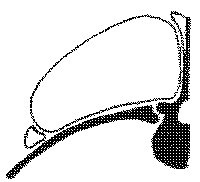
from those through the loin.
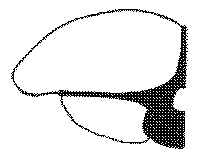
RIB versus TRANSVERSE Process OF LUMBAR VERTEBRA
ONE Heart OF MEAT versus Ii Eyes OF MEAT
 are sliced off perpendicularly to the humerus.
 Summit loin steak with big eye of longissimus dorsi.
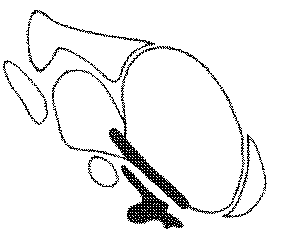
These steaks are, from anterior to posterior,
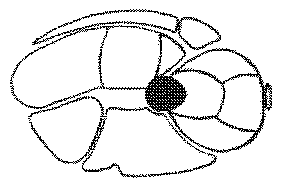 may be cut into full cut circular steaks** that are perpendicular to the femur, or it may be cutting into large pieces of meat parallel to the femur to create the inside or top round** (mostly semimembranosus and adductor) and the outside or bottom round** (mostly semitendinosus and biceps femoris). The semitendinosus sometimes is discrete and slices may be sold as the eye of the round**.
Cuts of veal
Veal carcasses are smaller than beef carcasses and there is less need to subdivide the carcass into primal cuts. Typical primal cuts are the forequarter, loin (from scapula to ilium), flank (from mid-sternum to tensor fascia lata), and leg (including sirloinX). The cuts of veal are quite modest, and many of the beef names are used since the overall pattern for beef is followed. The brisket unremarkably is called the breast in the veal carcass. The equivalent region to the T bone may be called a kidney chop if the kidney has been left in place and sectioned with the chop. Differences in tenderness betwixt cuts of meat from various parts of the veal carcass are far less pronounced than for the beef carcass.Cuts of pork
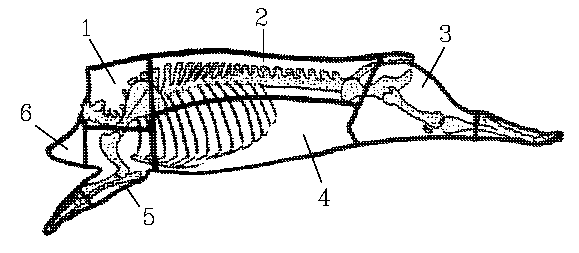
- Remove the hind human foot with a cut through the tuber calcis. Remove the front human foot with a cut that is just distal to the ulna and radius.
- Remove the leg with a cut that starts between sacral vertebrae 2 and 3 and which is then directed towards the tensor fascia lata.
- The cutting line is then inverse so that most of the tensor fascia lata is incorporated into the leg.
- The butt and picnic are removed together equally a shoulder, by a cut that is that is perpendicular to the vertebral column and which starts betwixt thoracic vertebrae 2 and 3. The barrel is separated from the picnic past a cut that skims past the ventral region of the cervical vertebrae at a tangent. This keeps the top of the picnic relatively square.
- The jowl is removed from the picnic with a cut that follows the crease lines in the skin.
- The rest of the side of pork is split into the loin and belly past a curved cut that follows the curvature of the vertebral cavalcade. One end of the bend is but ventral to the ilium, the other cease is just ventral to the bract of the scapula.
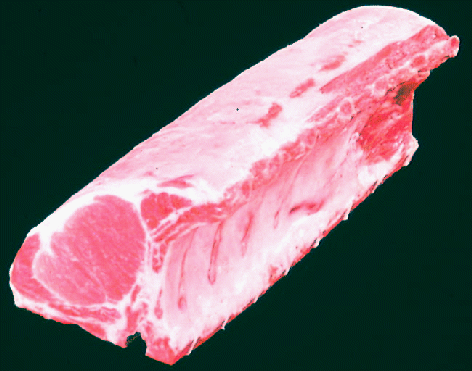
- The loin
- rib chops,
- middle loin chops and
- tenderloin chops.
- the rib end roast,
- center loin roast and
- tenderloin terminate roast.
- The psoas muscles may be removed from the lumbar region to make tenderloin, and the longissimus dorsi and side by side small muscles may be removed from the vertebral column, and rolled and tied to make boned and rolled loin roast.
- A crown roast tin can be fabricated by twisting the thoracic vertebral column into a circumvolve so that the stumps of the ribs radiate outwards similar the points of a crown. This facilitates the rapid carving and distribution of portions at a banquet.
- The longissimus dorsi may be cured and smoked to brand Canadian Style bacon or (equally it is more than often called within Canada) peameal bacon and back bacon.
- The rib cage plus its immediately adjacent muscles are removed from the belly to make the spare ribs.
- The remaining muscles of the abdomen, together with those that overlap the ribcage for their insertion, found the side of pork. Side of pork may be cured and smoked to make slab salary.
- The picnic may be sliced to brand picnic shoulder chops through the humerus, or it can be partly subdivided to brand picnic shoulder roasts. Picnic shoulder roasts may be boned and rolled, or smoked and cured in a multifariousness of ways.
- The butt, or Boston barrel, is usually divided into a number of bract steaks that are cutting from dorsal to ventral through the scapula. The more inductive part so forms a butt roast.
- The leg may be subdivided to create, from proximal to distal, the butt finish roast and the shank end roast. Alternatively, the leg may exist cured and smoked to brand ham.
- The anxiety, the hocks, the knuckles and the tail tin can exist baked or cooked in liquid and consumed enthusiastically with a large quantity of draft beer.
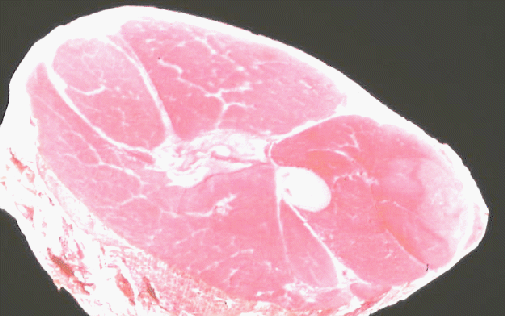
may be divided into a continuous sequence of chops. From anterior to posterior these are the
Cuts of lamb
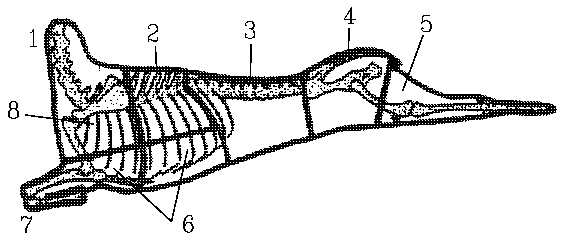
- The sirloin plus leg, or pivot bone leg, is removed by cutting perpendicularly through the vertebral column at a point level with the anterior confront of the ilium.
- In the lamb carcass, the loin includes part of the abdominal wall. The loin is removed past a cut that passes between ribs 12 and xiii and which and so continues perpendicularly through the vertebral column.
- Sometimes the whole breast and the shank are removed with a single cut from the anterior of the sternum to the ventral part of rib 11.
- Alternatively, the ascendant cut may exist fabricated between ribs v and 6, to divide the rib from the shoulder, and to divide the breast into inductive and posterior sections.
In the diagram, note how the metacarpal cannon bone is fixed back so that the carcass can be more easily transported.
- The leg may be divided a number of ways, either into leg chops*** or steaks*** that are cut perpendicularly to the femur, or into large or small roasting cuts. Like many other decisions made by the butcher, seasonal preferences are taken into account. Steaks and chops are pop in the summer while large roasts are more pop in the winter.
- Similarly, the sirloin either may be cut into sirloin chops***, or left every bit a sirloin roast***.
- The flap of abdominal muscle on the loin is removed, and is added to the chest meat.
- The loin is sliced into loin chops*** or left whole as a loin roast***.
- The rib or rack of lamb may exist subdivided into rib chops***, or left whole as a rib roast. The rack makes an excellent crown roast when the vertebral column is trimmed and aptitude back on itself.
- At that place are a number of ways in which to divide the shoulder. Information technology may be made into blade chops***, or left largely intact as a square shoulder roast***. Parts of the shoulder may be be boned and rolled to make Saratoga chops***.
- The neck* is usually sliced perpendicularly to the vertebral column.
- The fore shank* is removed intact, and the remaining breast* is subdivided in an arbitrary fashion.
- Much of the fat on the breast may be removed, and the remaining lean tin be rolled or cutting into riblets to conform to local preferences.
UK Meat Cutting
Imagine carrying a whole hip of beef and dropping it on a cutting block ready to work on. Information technology would be wise to drop it with the lateral surface downwards onto the block to exit the aitch os exposed and ready to remove. Thus, the medial surface of the hip becomes the UK topside - litteraly, it is on top. Between the semimembranosus (located medially, role of the topside) and the semitendinosus (located laterally and equivalent to the middle of the round in North America) is a natural seam that is opened to remove the silverside. Thus, from the program view beneath nosotros cannot meet that the topside is medial to the silverside, much every bit the inside round is medial to the outside round in N America. A final point to note is the location of the United kingdom spare rib of pork which corresponds to something like a Northward American blade or boston shoulder. In the UK, ribs and intercostals besides are cut from the abdomen, but are identified separately every bit barbecue spareribs. 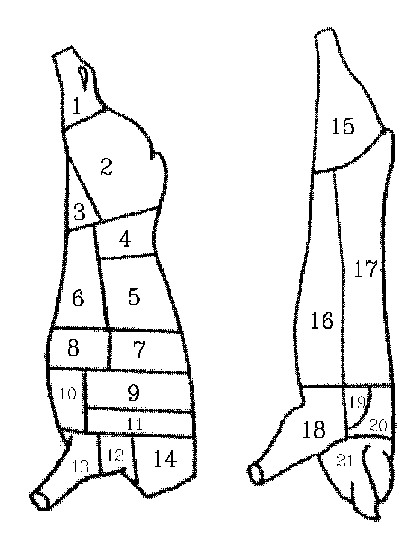 Beef cuts are the leg(1),
silverside and topside (ii),
tiptop or thick rump (3),
whole rump (4),
sirloin (5),
hindquarter flank (half-dozen),
fore rib (7),
forequarter flank (viii),
middle rib (nine),
brisket (10),
steakmeat (xi),
clod (12),
shin (13), and
sticking (14).
Pork cuts are the
leg (fifteen),
abdomen (16),
loin (17),
mitt & spring (18),
blade bone (19),
spare rib (20) and
head.
However, at that place are many other ways to break a carcass in the Great britain, where meat cutting is, or at least used to be, an elegant skill with artistic and literary pretensions.
Dr. Johnson's morality was an English an commodity as a beefsteak.
Nathaniel Hawthorne.
Japanese Meat Cutting
 The about striking feature of Japanese meat cutting is the complete removal of all basic and almost everything else that is not fat or musculus - including all lymph nodes, periostium, sinews, pare, ligamentum nuchae, and then on. Some types of Japanese beefiness are extremely fat with major seams of intermuscular fat, much of which may exist removed to leave highly marbled meat that is sliced very thinly and may be cooked apace at the dinner table, holding it with chopsticks and dipping it into lightly spiced boiling h2o. Thank you, Masa, for my business bill of fare in Japanese!
 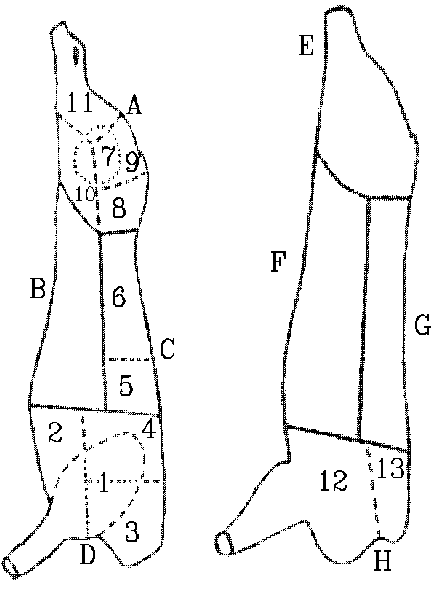 The central beef cuts removed from a hanging carcass are the front end quarter, tomobara, loin and round. The front end quarter includes the starting time six ribs and may exist angled slightly to follow the rib radius of curvature (D) . The arm and shank are removed from the front quarter much every bit a British butcher might remove a shoulder of lamb, that is, by lifting humerus and scapula together while cutting through the serratus ventralis where information technology attaches medially to the scapula and and so severing rhomboideus and trapezius (1). The arm and shank then are boned out to leave the sleeve of surrounding muscles as a retail cut. The remaining parts of the axial skeleton and musculature are separated into what might exist called a plate (rib and sternum, Figure 2), neck (cervical vertebral region, three), and shoulder roast (thoracic vertebral region, 4).
The sternum, xiphoid cartilage, ribs and costal cartilages are removed from the tomobara (B), which is roughly equivalent to plate and flank. The tomobara extends from rib 7 to the ilium, and contains the ventral ii thirds of rib length. The flat plate of boneless tomobara may exist cutting into three slabs. Having removed the tomobara from the hanging carcass, the psoas muscles are removed as a filet mignon.
The loin is separated into a rib and loin roasts perpendicularly to the vertebral column (5 and 6, respectively), only at that place seems to exist some variability in the plane of cutting: either between thoracic vertebrae 10 and 11, or betwixt 11 and 12.
The round (A), really more than like a hind quarter, has its medial muscle mass removed as an inside circular (7). This includes the pectineus, adductor and semimembranosus group that starts ventral to the pubis. The rump and outside round (8 and 9, respectively) are removed forth a line from the tip of the tensor fascia lata to the tip of the semitendinosus. The quadriceps femoris group of muscles (rectus femoris and the three vastus muscles) is removed as the shintana (10). All that remains is the hindshank composed of gastrocnemius and the distal extensor and flexor muscles of the hindlimb (xi).
For the pork carcass, the shoulder (H) is removed perpendicularly to the vertebral column between thoracic vertebrae 4 and 5, while the ham is removed at the lumbar-sacral junction (E). But sometimes the concluding lumbar vertebra may be left on the ham instead of the loin roast. Psoas muscles are removed as a filet. The roast (vertebral column and dorsal ribs, M) is removed from the bacon (abdomen and ventral ribs, F) past a line parallel to the vertebral cavalcade at nigh one third rib length. After boning, the shoulder is separated into arm and shoulder roasts at a line level with the top of the scapula (12 and 13).
Recognition of cuts of meat
- The recognition of the species of meat when cuts of beef, pork and lamb are displayed for sale equally top-quality fresh meat is based on the color of the lean and on the size of whole muscles and basic.
- Beef lean has the deepest color, and pork has the lightest color. Lamb and veal are intermediate, depending on the historic period of the animal. Veal from entirely milk-fed calves is extremely stake.
- If marbling fat is present as wavy lines and dots of white fat in the lean, it is very conspicuous against the nighttime colour of the lean in beef, merely is sometimes less visible in pork.
- Pork exhibits the greatest variation in depth of colour between different muscles.
- Pork often has the whitest fat, and beneath the subcutaneous fat may exist seen the thick cutaneous muscles of the pork carcass.
- Some pork cuts retain their peel.
- To place a cut of meat, first decide whether an unidentified cutting is from the left or right side of the carcass. Then define its position and orientation in the carcass. Practice non forget that left and right sides of the carcass course mirror images, and that the two flat surfaces of a chop or steak from i side of the carcass may also form mirror images. This is especially important when identifying muscles from diagrams.
- Examine the surfaces of the cut of meat, and look for a surface that might have been medial, as indicated by vertebrae, sternum, pubis, ribs, adductor musculus, gracilis, etc.
- Surfaces that were once part of the lateral surface of the carcass usually conduct traces of trimmed or untrimmed subcutaneous fat, ofttimes with a grade stamp.
- The orientation of a cut of meat may be indicated past the extent to which the cut of meat is tapered. The abdomen is narrower than the thorax in an eviscerated carcass, and the limbs are tapered from proximal to distal.
- The dorsal spines of most of the thoracic vertebrae project posteriorly.
- The anterior ribs are shorter than the posterior ribs.
- Look for a series of exposed blocks of porous bone. If a deep groove (neural culvert) runs through the series, the bones are vertebrae from along the animal'southward backbone. If no groove is present, the bones may exist part of the sternum. However, if a carcass has been poorly split into sides, the midline cutting may miss the neural canal.
- Look for rounded cantankerous sections of bone that might be from a limb, but think that part of the shaft of the ilium too is circular in cross section. The whole hindlimb is rounded in cross section, merely the forelimb is flattened because information technology is located against the rib cage. When the ilium has a rounded cantankerous section in a whole sirloin, the muscle mass is lop-sided, and at that place is some trace of the sacrum on the edge of the cut of meat. The more than posterior part of the shaft of the ilium is triangular in cross section (wedge os of sirloin). When the femur has a rounded cross section in the round, ham or hind leg, it is near in the centre of a circumvolve of meat.
- When the humerus or the shaft of the scapula have a rounded cross department in the chuck or arm region, information technology is alongside a series of transected ribs, and the muscle mass of the limb is oval in cantankerous section.
- Look for a section that has been cut through a flat bone.
- If it is rigidly part of the body of a vertebra, and if it is narrow, information technology may exist a wing-like transverse process of a lumbar vertebra from the loin.
- If it is rigidly part of a vertebra and is dorsal to the neural canal, and if it is ane of a series of wide porous sections of bone, information technology may exist a dorsal spine of a thoracic vertebra from the blade or rib region of the carcass.
- If it is curved and if information technology is movably jointed to a vertebra, it is probably the dorsal function of a rib (.
- If it is parallel to a vertebral procedure, or if it is joined past cartilage to a vertebra, it may be the flat part of the ilium from the sirloin.
- If it is isolated by itself in the meat, or if information technology is shaped like a letter T, information technology is probably the scapula.
- If in that location are no bones in the cut of meat, and if it is a flat slab of meat equanimous of several layers of flat muscles, it is probably part of the flank or intestinal wall.
- If the cutting of meat has large vertebrae with a complex shape, and if the outer surface of the meat is dark and ragged, the meat is probably from the cervix.
- If the outer surface of the cutting of meat contains a flat rounded area of os with a dimpled surface and traces of dried cartilage, the bone is the pubis from the rump region.
- Look for a hole in the meat where the carcass might have been suspended from a large hook or gambrel. This indicates a hind leg, or the heel of the round in beef. In beef, the achilles tendon is hard, dry, pale yellowish in color, and extremely strong.
- Await for a series of parallel ribs. The inductive ribs are shorter than the posterior ribs, and anterior ribs connect direct to the sternum.
- Look for a long flap of muscle that runs diagonally over the medial surfaces of the ribs. This flap of muscle is the diaphragm. The ventral part of the diaphragm is anterior to the posterior function. In the beef carcass, the inductive office of the diaphragm appears in the plate, and the posterior part of the diaphragm appears at the start of the short loin, in the wing or club steak region.
- Look for a ball and socket joint. The socket of the scapula in the chuck region of the carcass is wide and shallow. The socket that forms the acetabulum of the pelvis is narrow and deep, and there may be a trace of the ligament which holds the head of the femur into the socket. The acetabulum occurs at the junction of the rump, the round and the sirloin. In pork and lamb, the acetabulum may exist contained in the top of the ham or leg.
- Look for a small-scale loose bone that would fill a cupped hand. This is the patella of the hind limb.
- Wait for the stump of the tail, with its small, simple caudal vertebrae.
- Look for a series of small circular sections of white cartilages. These are the costal cartilages from the plate, flank, belly or chest.
- Look for groups of several small muscles, each surrounded by white fibrous tissue. These are the extensor and flexor muscles from the distal part of a limb. The Achilles tendon indicates the hind limb.
CARCASS GRADING
The primary objective of carcass grading is to depict the value of a carcass in clearly defined terms useful to the meat industry. It is advantageous to both the heir-apparent and to the seller if the chore of grading the carcass is left to an impartial third party - the federal grader. If the buyer and the seller have worked out their own organisation of payment for high and for low value carcasses, they can relieve time or money by not having the carcass federally graded. The federal grading of carcasses facilitates long distance transactions and contracts for future shipments in which one or both parties have non yet examined the carcasses.Quantity and quality
3 major factors determine the value of a carcass relative to market place weather condition, (1) carcass weight, (2) the cutability or yield of saleable meat, and (iii) the quality of the lean meat. All three factors are continuous variables that may exist measured in either absolute terms, such every bit weight, or in relative terms, such as those used by a taste console. In scientific experiments, authentic carcass evaluation is necessary to search for minor differences beteween carcasses. Simply a less accurate organisation is adequate for commercial transactions, and the continuous spectrum of carcass properties is subdivided into a relatively minor number of grades in a step-wise sequence. Thus carcasses that are placed in the aforementioned grade may exhibit minor differences, merely carcasses that are placed into dissimilar grades should exhibit much larger, and commercially significant differences.Since 1972, the Canadian beef grading organization has encouraged a tremendous reduction in the corporeality of fatty on beef carcasses. But, by 1987, consumer responses indicated that the tenderness of beef was a business organisation and, in 1992, the grading system was contradistinct to include a measure of marbling and to make information technology at partly compatible with USDA beef grades. The marbling is now given by a rating for Canada's acme grades.
A - must comprise a least traces of marbling
AA - must contain slight marbling
AAA - contains pocket-size or greater marbling
All these A grades are from youthful animals with musculus that is bright red, house and fine grained and fat that is firm and white. The quality form (A, AA or AAA) is marked on each of the four quarters of the carcass within a maple leaf badge.
Yield grading for Canadian beefiness carcasses is now a separate system. At present (I often out of appointment), yield grade A1 has >59% lean, A2 has 54 to 58% lean, and A3 has <=53%. The yield class is determined past measuring the exterior fat, and the length and width of the rib- eye. The grader has a special ruler. Firstly, the fat depth (mm) is measured at a unmarried site over the fourth quarter of the loin- eye using some notches on the ruler although, biologically, there is no guarantee that fatty is spread uniformly all over the carcass. There are nine fat classes, the first starting at 4 mm and the last at twenty mm of fat depth (stride size = 2 mm). Next, the ruler is used to measure the loin-center length and width, merely this is simply an approximate measurement where the dimension is taken as less than the box marked on the ruler (measurement = 1), within the box (= two), or greater than the box (=3). These measurements and so are used with a expect-up-tabular array (LUT) on the ruler to obtain a musculus score. The muscle score is and then used together with the fatty class in some other LUT to notice the estimated lean yield. The estimated lean yield then places the carcass as either A1, A2 or A3, which is marked all down the carcass in cerise ink with a roller. The lesser grades are more simple. Class B carcasses are all from youthful animals that missed the A class for one reason or some other: B1 for those without whatever marbling or with less than 4 mm exterior fatty, B2 for those with yellow fat, B3 for those with poor muscling, and B4 for dark-cutters. Grades D and East, which are seldom used, are for mature cattle used for ground beef or meat processing. The current beef grading organization in Canada has only 2 maturity groups.
Diagnostic features of maturity in Canadian beefiness grading.
YOUTHFUL
1. Cartilagenous caps on the thoracic vertebrae not more than half ossified (T one to 3).
2. Lumbar vertebrae with show of cartilage or a red line on the spinous process tip (50 1 to v),
3. Red, porous spinous processes when split.
4. Narrow, round, red ribs.
5. Sternebrae not fused.
MATURE
1. Thoracic caps more than half ossified.
2. No cartilage or cherry line on lumbar vertebrae.
3. Hard, white, flinty barbed processes when split.
4. Broad, flat, white ribs.
5. Ossified sternum.
Pork grades in Canada
Pork grades are used in Canada to pay a producer for the amount of saleable meat that has been produced. The organization is based on the inverse linear human relationship that exists between full backfat and the pct yield of the ham and loin. The dorsal spines of the thoracic vertebrae remain on the left side of the carcass when it is split into sides. The fat depth is measured vii cm from the midline between ribs iii and 4 with an optical probe. A LUT is used to summate the grade (chosen the index) from a combination of the backfat measurement and the warm carcass weight. Exceptions to the LUT are: (one) ridgelings (cryptorchids) all class at 67, (2) emaciated carcasses all grade at 80, (3) 3 index points may exist deducted for a badly shaped belly, (4) 10 alphabetize points may be deducted for aberrant fat color or texture, (five) tissue trimmed off by a meat inspector considering of defects with a farm origin reduces the carcass weight.The farm of origin is identified by a shoulder tattoo on the pork carcass, and the producer is paid the numerical product of the reported marketplace toll, the class, and the carcass weight.
Source: https://animalbiosciences.uoguelph.ca/~swatland/ch3_0.htm

Postar um comentário for "Is the Beef Carcass Has a Spare Rib"