Coming Back Out Again Ball in Australia
Review: The Coming Back Out Ball
At a time of increasing threats to basic civic decency, the acceptance of LGBTIQ rights, as they are often called, has become a comfort blanket for progressively-minded people. In the year following the marriage debate, it is not surprising that the Melbourne International Film Festival chose The Coming Dorsum Out Ball every bit their closing night gala event.
The Coming Dorsum Out Ball is a documentary of an upshot of the same name held in Oct 2017 in the Melbourne Town Hall. Information technology aimed to include and honour elders of the LGBTIQ customs. (The indigenous use of "elder" is increasingly used in queer political circles.) It was an extraordinary outcome, attended by hundreds of people — for those in the community over 65 it was free — which combined dinner, dancing and a floorshow compered past Robyn Archer.
Equally journalist Gay Alcorn wrote in a long and loving account of the Brawl:
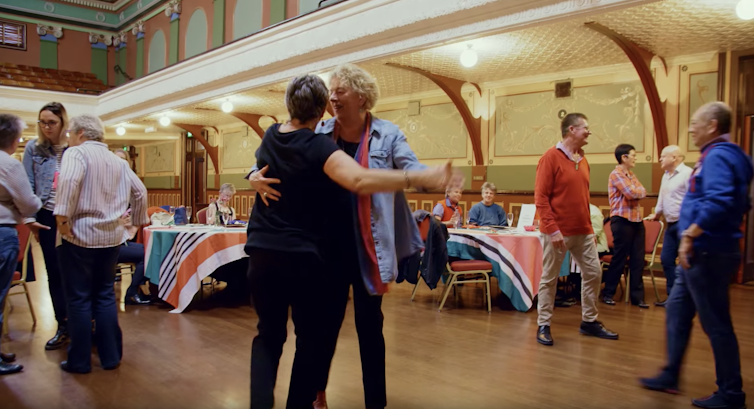
They arrived in sequins and feathers, vi-inch heels and pancake makeup. They arrived, too, in T-shirts and hiking boots, frocking upward for no one. There were walking sticks and wheelchairs, a blind man with a guide dog, a woman with a shirt saying "This is what an old lesbian looks like". This was their night, and they'd come as they delight.
The film sets out to bear witness the lead up to the Ball, but peculiarly to tell the story of 12 of the "elders" whose stories helped inspire a younger generation to organise the effect. Cardinal to this story is the operation creative person Tristan Meecham, who over several years worked with his collaborator Bec Reid to provide space for queer elders to join together in social dancing.
Tristan and Bec appear briefly in the film, only I left wanting to know much more virtually what drove Tristan to become such a central figure in creating a remarkable establishment, i that says a lot almost the city and country governments likewise as the richness of queer cultural life in Melbourne.
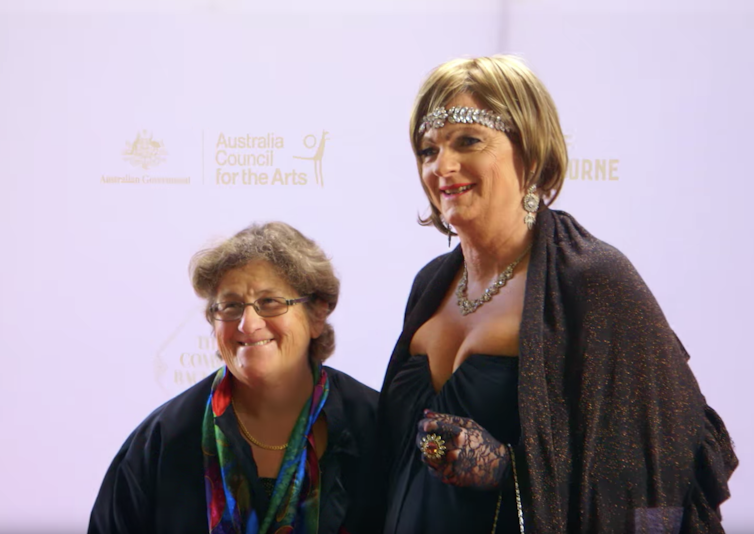
The film concentrates largely on a group of older lesbians, gay men, one transwoman and one intersex person, all of whom tell stories of living their lives under the shadow of ignorance, self-denial and sometimes persecution. A couple of the women in detail are remarkable characters, lightening up the screen by the sheer forcefulness of their personality.
Only the trouble with trying to tell social history through individual stories is that it can merely capture certain strands. Ane of the men referred to a partner long dead from AIDS. The but long lasting partnerships depicted are two heterosexual marriages, one between ii people who conveniently both discovered their homosexual desires and separated amicably, the other a transwoman whose marriage has been stretched by her transition at the historic period of 60.
There are plenty of older lesbians and gay men living in very long established relationships, but we exercise not encounter them. Unconsciously the film reproduces some of the sillier claims of the marriage movement, that just with legal recognition could queers grade committed lifelong partnerships.
At to the lowest degree i of the women in the film has a long history of activism, as her flamboyant t-shirts brand clear, merely political agency is denied in the stories, except for a couple of passing clips from early gay liberation protests. The film tells the states that things have become easier for those of united states of america who live outside the heterosexual norm; it makes no attempt to tell us why.
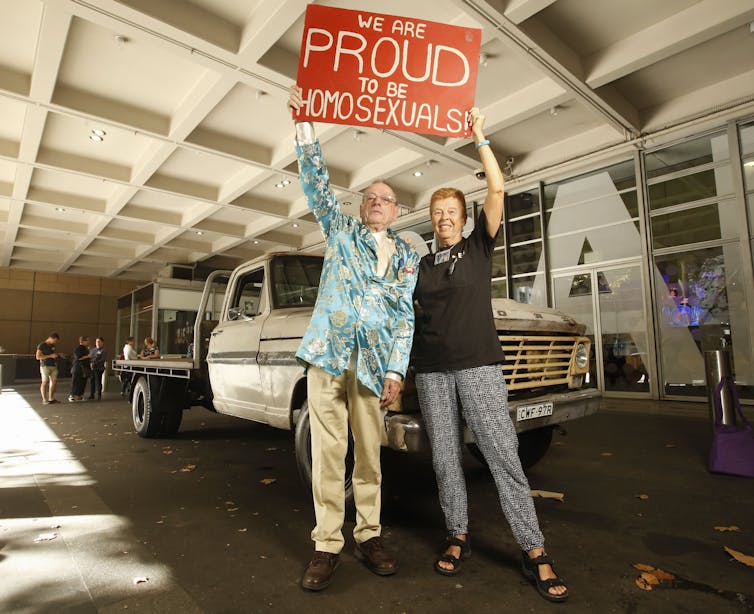
Even so many of the early activists were at the Ball that evening, and it would have been piece of cake to accept spoken with some of them. Potent every bit the personalities on moving picture are, they almost all reinforced a certain monolithic picture of victimhood and darkening that suits the progressive narrative.
There have been several Australian cinemographic attempts to capture the changes in attitudes towards sexual and gender fluidity in the past year. Jeffery Walker's film Riot focused on a very different story, namely the Gay and Lesbian Pride Parade in Sydney in 1978 which led to massive police reaction, and became the basis for the city's Mardi Gras. Riot was of class a very political flick, but over again one that told the story of queer progress through the lives of a few individuals, making a couple far more significant than they actually were at the time.
Telling the story of social and political change requires key individuals with whom we can identify, and I applaud the makers of The Coming Back Out Ball for using people who are non already well known.
But this device as well risks oversimplification, and painting an anodyne motion-picture show of history. The underlying bulletin of The Coming Back Out Ball seems to be that now we can all notice our authentic selves, and perhaps live happily always afterwards, if not necessarily for very long.
This assumes that there is an authentic self, and that political progress allows u.s.a. the liberty to observe our "true identity". Yet equally the British critic Jonathan Dollimore wrote:
Information technology's one of the delusions of identity politics to call back that our desire comfortably coexists with our identity, a belief which has more to do with consumerism than desire. I've come to feel that sexuality might at different times express unlike aspects of i's cocky, a situation farther complicated by the fact that the self changes.
My memory of the Ball is that it both reinforced and subverted identities, that it immune people to mix beyond lines of gender, sexuality and age in ways that should not be reduced to the politically acceptable terminology that confuses sexual desire, gender expression and physical feel.
Baca juga: The term 'LGBTI' confuses want, behaviour and identity – it's fourth dimension for a rethink
As I grow older I am happy to be honoured, and I loved the women who early on in the flick talk about the need for an early kickoff and a sit down down dinner. But for i evening at least the Ball allowed people to mingle across lines of grade, gender and, above all, generations.
The film ends with a very uplifting moment for one of the women, which I will conscientiously non reveal. But somewhere it lost the exuberance and magic that Tristan conjured up that evening in the Melbourne Town Hall. The best news of the night is that the Ball will happen again later on this year.
The Coming Back Out Ball screened as function of the Melbourne International Film Festival.
Source: https://theconversation.com/the-coming-back-out-ball-is-a-film-that-honours-queer-elders-but-avoids-rocking-the-boat-101820

Postar um comentário for "Coming Back Out Again Ball in Australia"